
Social responsibility and ethical leadership – firmly embedded
in our day-to-day activities.
We act in a socially responsible manner – in our day-to-day interactions and at every stage of our corporate governance. In doing so, we are committed to a fair and healthy working environment and to decisions that are made transparently, with a long-term perspective and in line with our values.

Specific measures: what we are doing
Health & Wellbeing
Regional Involvement
Corporate Culture
Transparency & Regulatory Approach
Further Training
Equality, Diversity & Inclusion
For us as a family, sustainability means never standing still. It is a journey we undertake every day together with our staff. Throughout the company, we are constantly looking for new ways to ensure the well-being of our team, protect the climate and fulfil our social responsibility towards future generations.
FAQ‘s
In the current construction sector, the term ‘EPD’ is frequently heard. EPD stands for Environmental Product Declaration and is a Type III environmental label. It contains environmental information in a standardised format, but does not include an assessment and is not a certificate. However, the use of products with EPDs is relevant for many building sustainability certifications. LEED certification, for example, requires the use of a certain number of products with EPDs or reviewed LCAs.
LCAs are mentioned less frequently in this context, yet every EPD also incorporates an LCA. LCA stands for Life Cycle Assessment and represents an environmental assessment of a product across its entire life cycle. The step from an LCA to an EPD then involves the creation of a standardised structure (PCR – Product Category Rules) for an entire sector and verification by an independent body.
As there is not yet a standard in the form of a PCR for our sector, but we nevertheless wanted to assess the impact of our products, we have decided to carry out an LCA for our products in order to present their environmental performance across their entire life cycle.
The abbreviation SDGs stands for Sustainable Development Goals. These are 17 global goals set by the United Nations (UN), which were adopted in 2015 as the centrepiece of the 2030 Agenda to ensure socially, environmentally and economically sustainable development worldwide by 2030.
These 17 SDGs are broken down into a further 169 sub-goals (targets) and embody a new, interconnected understanding of poverty, environmental degradation, inequality, patterns of production and consumption, and corruption, to name but a few examples. It has been recognised that various problems must be tackled everywhere and simultaneously. The universality of the Agenda means that all the goals apply to all countries. Responsibility for implementing the goals therefore lies at both the national and international levels.
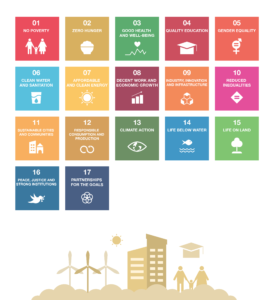
We take comprehensive environmental and social responsibility across all areas of our business. From future-proof product development to strict ESG criteria. As pioneers in sustainable sanitary accessoires, we align all our business activities with the United Nations’ (UN) 17 Sustainable Development Goals (SDGs).
Across the various sections of the website, we provide a transparent account of how and which specific goals we are implementing in detail for environmental protection and society.
An ESG report is a document in which companies disclose their performance in the areas of the environment, social issues and corporate governance. It serves as evidence of the company’s actual sustainability for investors, customers and regulatory authorities.
The acronym ESG stands for three key assessment areas:
The three pillars of ESG
- E (Environmental): Measures relating to climate protection, CO₂ emissions, energy efficiency, waste management and resource conservation
- S (Social): Treatment of employees, health and safety at work, fair wages, diversity, human rights and community engagement
- G (Governance): Transparent leadership, anti-corruption measures, independence of the supervisory board and compliance with the law
No, PROOX GmbH is not legally obliged to produce an ESG report. As an SME (small and medium-sized enterprise), we fall below the statutory thresholds set out in the European CSRD-Richtlinie (Corporate Sustainability Reporting Directive), which only requires larger organisations to report. Nevertheless, we are deeply committed to sustainability and wish to demonstrate this transparently.
The EmpCo Directive (Empowering Consumers for the Green Transition) is an EU law designed to combat greenwashing. The aim is to ensure that companies make their sustainability communications transparent and back them up with scientific evidence. Vague terms such as ‘climate-neutral’ may not be used without evidence.
It’s easy to lose track of things in the jungle of sustainability promises and certificates. That’s exactly what happened to us when we first started looking into the topic of sustainability. It quickly became clear to us that we didn’t want to use superficial marketing clichés. We wanted to engage seriously with the issue and adopt a scientific approach. That is why, with the help of external partners and their established methods, we calculated and analysed our company’s carbon footprint and the environmental impact of our products in the form of a life cycle assessment (LCA). This enables us to explain our sustainability promises and make them transparent with a clear conscience.
CCF stands for Corporate Carbon Footprint, which refers to our company’s carbon footprint. The CCF encompasses all greenhouse gas emissions caused directly and indirectly by our company. The calculation is based on the Greenhouse Gas Protocol.
We calculate the carbon footprint by taking into account all greenhouse gases, including, amongst others, carbon dioxide (CO₂), methane (CH₄), nitrous oxide (N₂O), hydrofluorocarbons (HFCs), perfluorocarbons (PFCs), sulphur hexafluoride (SF₆) and nitrogen trifluoride (NF₃). Greenhouse gases differ in terms of how much they contribute to warming the Earth’s atmosphere and how long they remain there. To present their climate impact in a comparable way, all gases are converted into so-called CO₂ equivalents (CO₂e). The basis for this conversion is the global warming potential (GWP), which indicates how potent a gas is compared to CO₂ over a period of usually 100 years. Our figures are therefore given in tonnes of CO₂e.
The Greenhouse Gas Protocol (GHG Protocol) is the world’s most widely used and recognised standard for calculating and managing greenhouse gas emissions. It was developed in the late 1990s by the World Resources Institute (WRI) and the World Business Council for Sustainable Development (WBCSD). The Protocol ensures that the carbon footprints of companies, countries and cities worldwide are consistent, comparable and transparent.
The 3-Scope Model (Classification of Emissions)
The most important core concept of the GHG Protocol is the division of emissions into three different categories, known as ‘scopes’:
- Scope 1 (Direct Emissions): Emissions from sources that the organisation directly owns or controls.
- Examples: Burning gas in the organisation’s own boiler; fuel consumption by the organisation’s own vehicle fleet.
- Scope 2 (Indirect Emissions from Purchased Energy): Emissions resulting from the generation of energy that the organisation purchases from external sources.
- Examples: Purchased electricity, district heating or steam for production.
- Scope 3 (Indirect emissions in the value chain): All other indirect emissions resulting from the company’s activities but originating from sources over which it has no direct control.
- Examples: CO₂ emissions from the production of purchased raw materials (such as stainless steel), logistics and transport by service providers, staff business travel, or the use and disposal of the products sold.