Life Cycle Assessment (LCA) –
Transparency throughout the entire product life cycle
Sustainable sanitary products must demonstrate their merits throughout their entire life cycle. That is why we have carried out a life cycle assessment (LCA) for our stainless steel sanitary accessoires. A Life Cycle Assessment (LCA) forms the basis for the environmental assessment of a product across defined life cycle stages. It systematically analyses environmental impacts and provides reliable data on a product’s Life Cycle Assessment. An EPD (Environmental Product Declaration) is always based on an LCA, but supplements it with a standardised structure and is verified by an independent body. As there is currently no industry-wide standard (PCR) for sanitary accessories, we have deliberately decided for an LCA – so that we can present the environmental impacts of our sustainable stainless steel products in a transparent and verifiable manner right now.
What is a Life Cycle Assessment (LCA)?
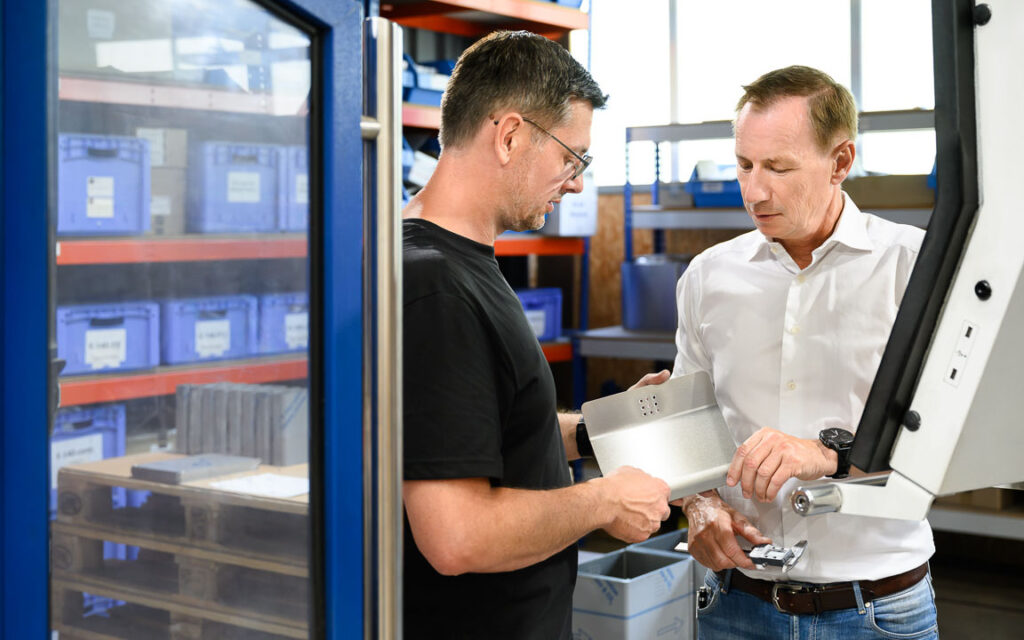
A Life Cycle Assessment (LCA) evaluates the environmental impacts of a product across clearly defined stages of its life cycle.
This includes the extraction of raw materials, …
transport and the manufacture of the finished product. The aim of an LCA is to present environmental impacts in a transparent, comprehensible and comparable manner.
In the construction and planning sector, LCA is regarded as the scientific basis for assessing the environmental performance of materials and products. It provides a sound basis for decision-making regarding sustainable sanitary products and long-lasting solutions in the building sector.
LCA and EPD – what is the difference?
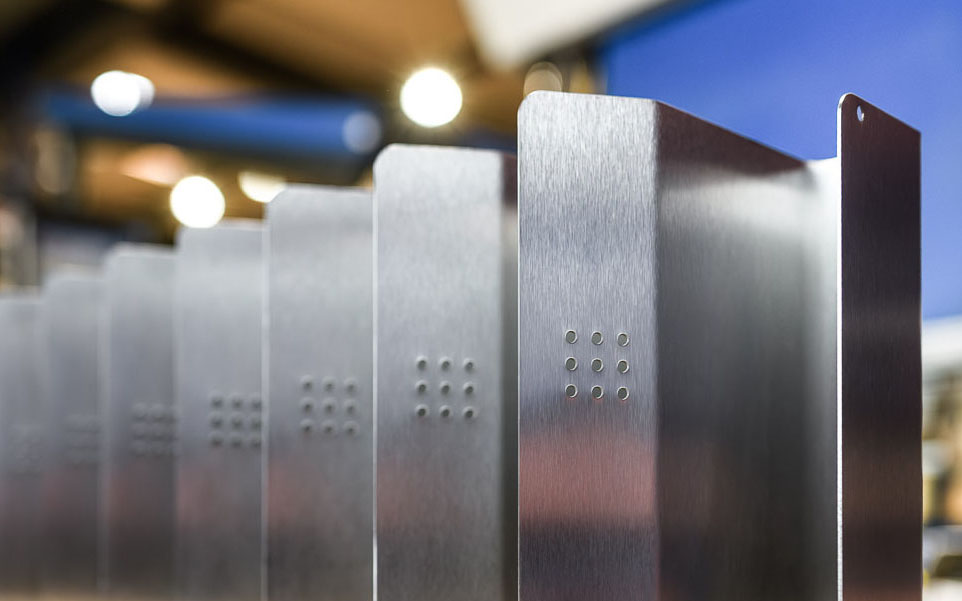
A Life Cycle Assessment (LCA) forms the basis for the environmental assessment of a product across defined life cycle stages.
It systematically analyses environmental impacts…
and provides reliable data on a product’s Life Cycle Assessment.
An EPD (Environmental Product Declaration) is always based on an LCA, but supplements it with a standardised structure and is verified by an independent body. As there is currently no industry-wide standard (PCR) for sanitary accessories, we have deliberately decided for an LCA – so that we can present the environmental impacts of our sustainable stainless steel products in a transparent and verifiable manner right now.
The basis of our Life Cycle Assessment
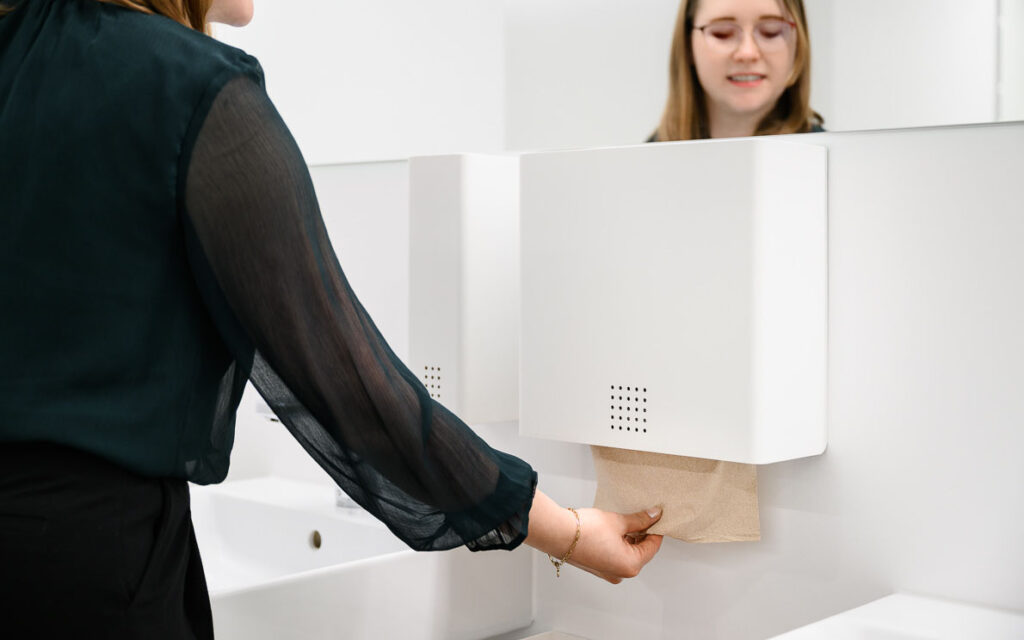
For the Life Cycle Assessment of our sustainable sanitary accessoires, we examined seven representative product categories – ranging from products made entirely of stainless steel to those with a low plastic content.
The assessment is carried out…
per 1 kg of finished product and enables a comparable presentation of the Life Cycle Assessment.
The life cycle stages analysed were raw materials, transport and manufacturing (A1–A3). This enables us to establish a sound basis for assessing our durable bathroom fittings and the materials used.
The ecological assessment of our products
Two main groups were considered for the ecological assessment:
Stainless steel products
(e.g. paper towel dispensers, waste bins)
Composite products with low plastic content
(e.g. soap dispensers, toilet brush sets, sanitary waste bins)
A total of 7 product categories, each with 3 different surface finishes, were considered and divided into the two main groups. The results refer to the average of all products in the product group and apply to 1 kilogram of finished product (declared unit).
The analysis covers modules A1–A3 (raw materials, transport, manufacturing) and is based on the ecoinvent database and EN 15804.
LCA-Results:
Stainless steel products
(e.g. paper towel dispensers, waste bins)
Mixed products with low plastic content
(e.g. soap dispensers, toilet brush sets, sanitary waste bins)
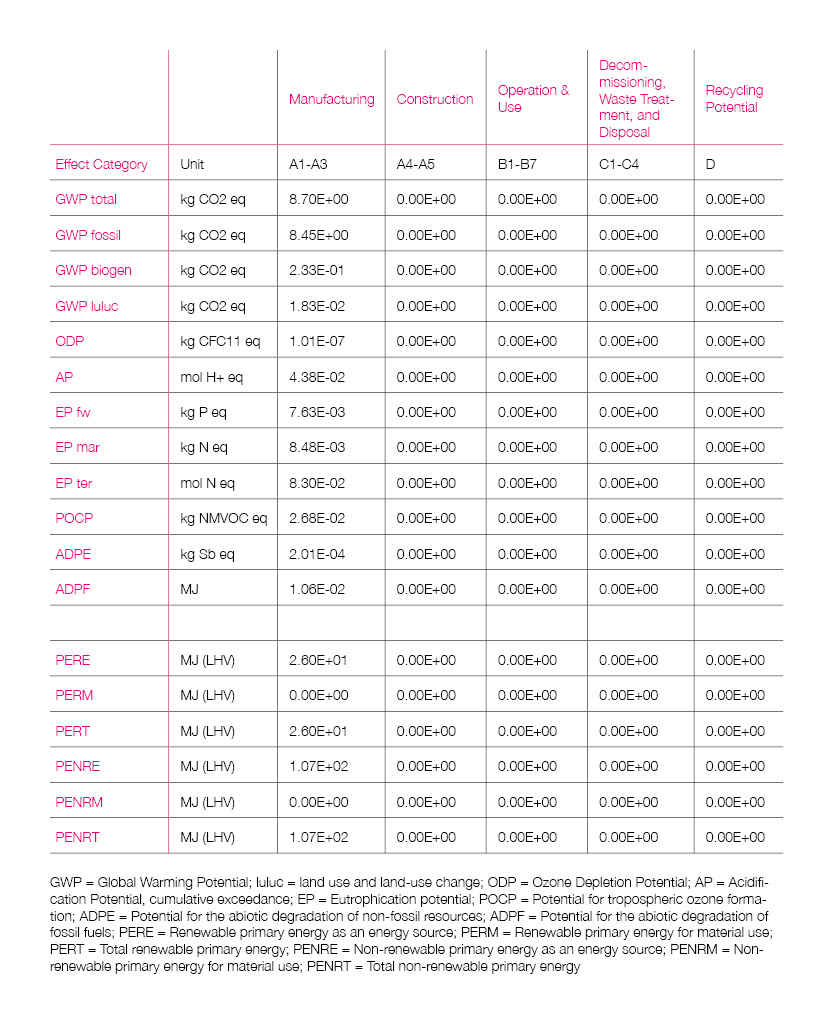
1. Pure stainless steel products
The following products were included in the calculations for stainless steel products.
The unit stated is 1 kg of finished product. To obtain the environmental impact of a specific product, the results must be multiplied by the respective weight of the finished product.
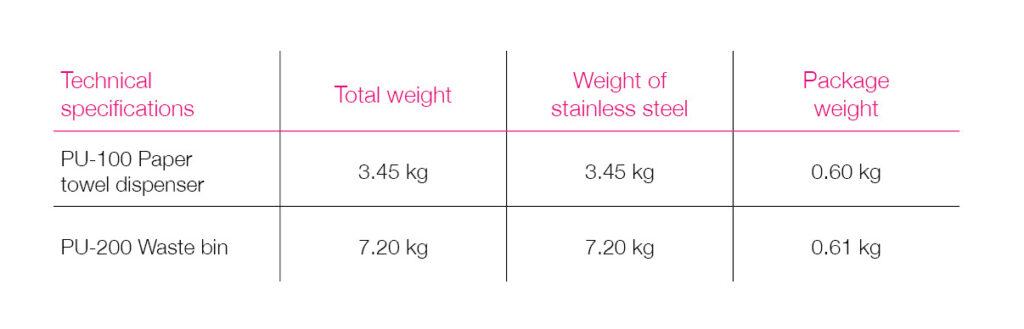
The following table sets out the individual environmental indicators, broken down by life cycle stage, which have been calculated for products in the stainless steel products category.
2. Stainless steel and plastic products
The following products were taken into account in the calculations for blended products.
The unit stated is 1 kg of finished product. To obtain the environmental impact of a specific product, the results must be multiplied by the respective weight of the finished product.
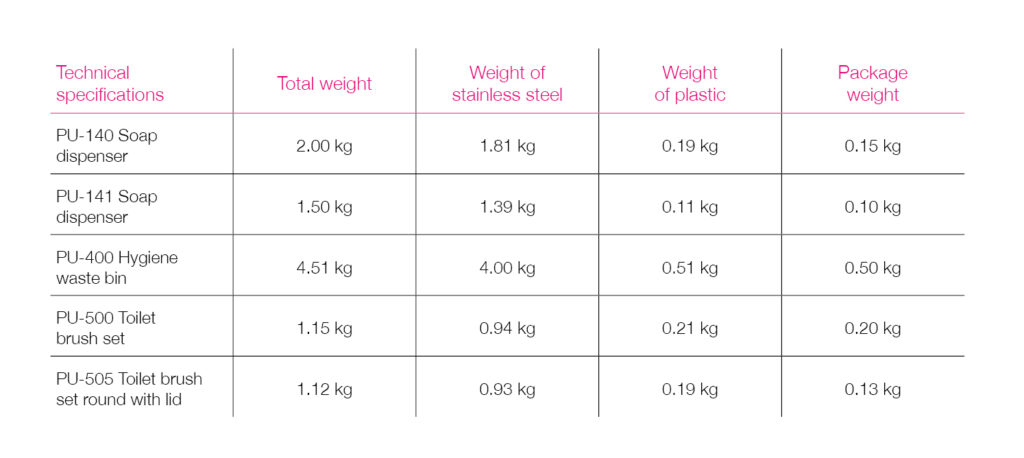
The following table sets out the individual environmental indicators, broken down by life cycle stage, which have been calculated for products in the ‘mixed products’ category.
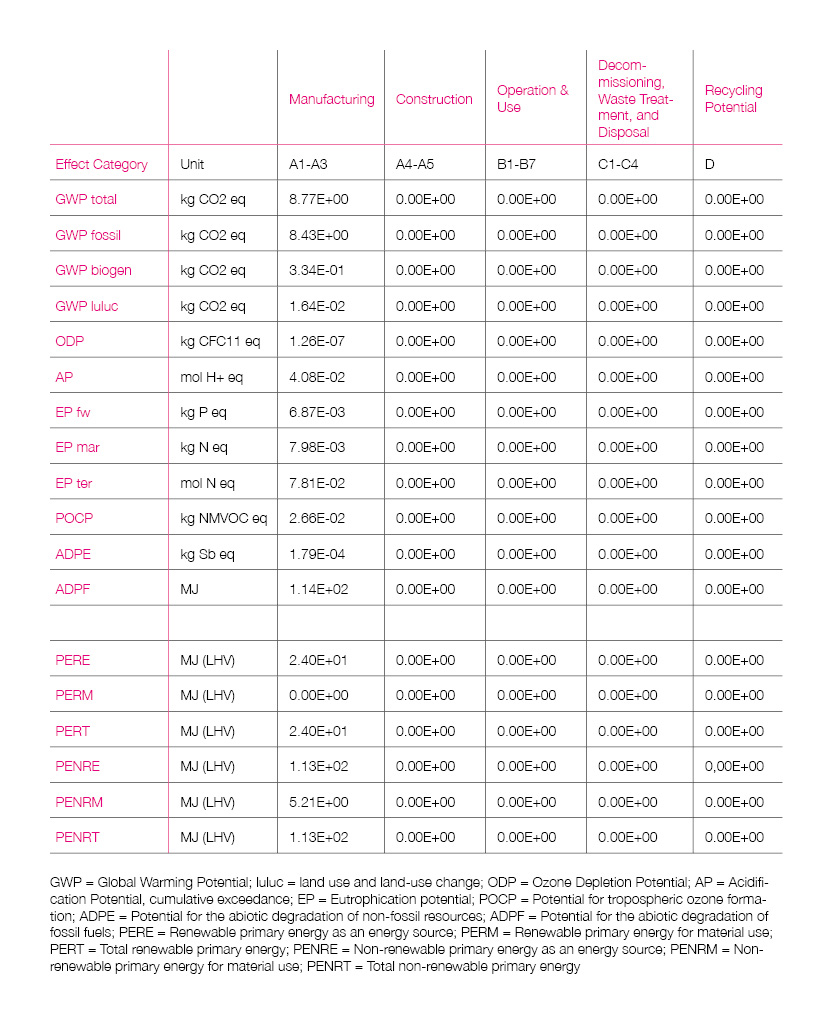
The LCA shows that:
Thanks to durable stainless steel products with high recyclability, the environmental impact over decades is lower than that of plastic solutions.
An overview of the LCA results
Stainless steel is characterised by a long service life, reparability and a recycling rate of around 95 %. Shorter replacement cycles can help to reduce emissions over the life cycle. It is crucial to consider the entire life cycle, as the service life has a significant impact on the overall balance. Low-carbon sanitary products can – depending on their design and application – contribute to buildings that can be used sustainably over the long term.
Why the choice of material
determines the life cycle
the environmental impact of sustainable sanitary products during the manufacturing phase is largely determined by the materials used. Stainless steel and its processing are the key factors here – regardless of whether the products are made entirely of stainless steel or contain a small proportion of plastic.
However, it is not manufacturing alone that is decisive for a sustainable life cycle assessment, but the entire life cycle of a product. This is precisely where the strength of stainless steel’s sustainability lies: stainless steel products have a service life of around 80 years, are easy to repair and are approximately 95 % recyclable. This significantly reduces replacement cycles and conserves resources in the long term.
may in some cases have lower initial production figures, according to the manufacturer’s specifications they often need to be replaced after around 7 years. Over time, these short usage cycles lead to additional emissions from materials, transport and manufacturing. When considering the entire life cycle, this results in a greater environmental impact than that of durable stainless steel products.
The LCA thus clearly demonstrates why durable, repairable stainless steel products make a decisive contribution to low-carbon sanitary solutions and sanitary fittings that conserve resources in the long term.

>> Sustainability is not achieved through short-term benefits,
but through products that last for decades. <<
From analysis to accountability
Sustainability as an ongoing process
The results of the life cycle assessment confirm what we have long maintained: durable, repairable stainless steel products are a key component of truly sustainable sanitary solutions. The LCA provides a transparent, fact-based foundation for this and makes environmental impacts transparent.
At the same time, we do not view life cycle assessment as a one-off exercise, but as an ongoing tool. The insights gained are specifically incorporated into the further development of our products and packaging solutions, as well as into our manufacturing and transport processes. Our aim is to continuously improve the environmental performance of our bathroom fittings and to provide relevant product data transparently to architects and planners.